
We install TPO roofing systems on low-slope commercial buildings and repair TPO roofs that are already leaking, across all five boroughs, Westchester and Nassau.
$2M general liability insurance
TPO roofing is a heat-welded thermoplastic membrane for low-slope commercial roofs. It’s one of three systems we install and repair in New York, and all roofing systems compares it against the other two in full.
This page covers what a TPO roof is made from, how installers hold it down, why it succeeds or fails at the seams, and what a repair actually involves, for anyone specifying TPO or already living with one that leaks.

TPO stands for thermoplastic polyolefin. Manufacturers build the sheet around a polyester scrim that gives it tear strength and puncture resistance. The thermoplastic base makes the sheet heat-weldable. A hot-air welding machine softens the surface of two adjoining sheets and fuses them into one continuous layer, so the seam doesn’t depend on adhesive or tape.
Most manufacturer lines ship TPO white as the standard color, which keeps the roof reflective without an added coating. Gray and tan sheets exist too, for buildings where a white roof isn’t part of the brief.
None of this sits directly on the deck. Insulation goes underneath the membrane, often with a cover board that protects the insulation and gives the TPO sheet a stable, even surface to weld against. Whether the job is new roof installation and replacement or a fix to what’s already up there, this layered build is the starting point for both.
Installers commonly use one of three assemblies on a TPO roof: mechanically attached, fully adhered or ballasted. Mechanical attachment fastens the membrane through the insulation into the deck at set intervals. Full adhesion skips the fasteners and bonds the sheet down with adhesive across the whole surface. Ballasted systems use loose stone or paving pads to hold the membrane down with no fasteners or adhesive at all.
Deck type, building height and wind exposure decide which assembly a roof gets, not preference. A steel deck on a low building calls for a different assembly than a taller structure with more wind exposure, and the specification usually settles this before a contractor gets involved.
A TPO roof depends on its seams more than any other part of the system. Hot-air welding machines run the field seams, melting the surface of both sheets and fusing them as the roller passes over. Hand-held irons handle what a machine can’t reach: corners, T-joints, curbs and penetrations.
Crews test the welder’s settings on a scrap piece before the first production weld, then probe every finished seam with a rounded tool, checking for a soft spot that hasn’t fully bonded. That step catches a weak seam while it’s still on the roof, not after the first heavy rain.
T-joints, corners and penetration details take longer to weld correctly than a straight field run, and that extra time prevents most leaks later. Many TPO leaks develop at seams, curbs, penetrations and other details rather than in the open field. Keeping a membrane roof in service after installation depends largely on maintaining these same details, which is what keeping a membrane roof in service covers in full.
Send us a photo of a seam and the building address, and we’ll tell you what we’re looking at.
TPO ranks among the more repairable commercial roofing systems. A properly welded repair fuses into the existing membrane instead of relying on a separate adhesive layer.
Many TPO repair issues occur at details rather than in the open field: a split at a penetration, a lifted flashing at a curb, a weld that opened at a corner. Fixing it means cleaning the area, welding a compatible patch over it, and testing the new seam the same way crews should test the original weld.
A repair makes sense when the membrane itself is sound and the damage is localized. It stops making sense once the membrane has aged past the point of welding cleanly, once moisture has already reached the insulation below, or once a roof has enough failed details that patching one leak only shifts the problem to the next.
An older TPO surface can need extra cleaning or a primer step before a new weld holds. That’s why a repair call is worth a site visit, not a phone estimate. Most of these come in as scheduled roof repair. If a weld has already opened and water is coming in right now, that’s 24/7 emergency roof repair instead.
A few signs it’s worth a call before the next storm:
Working to a specification that already says TPO? Send it over.
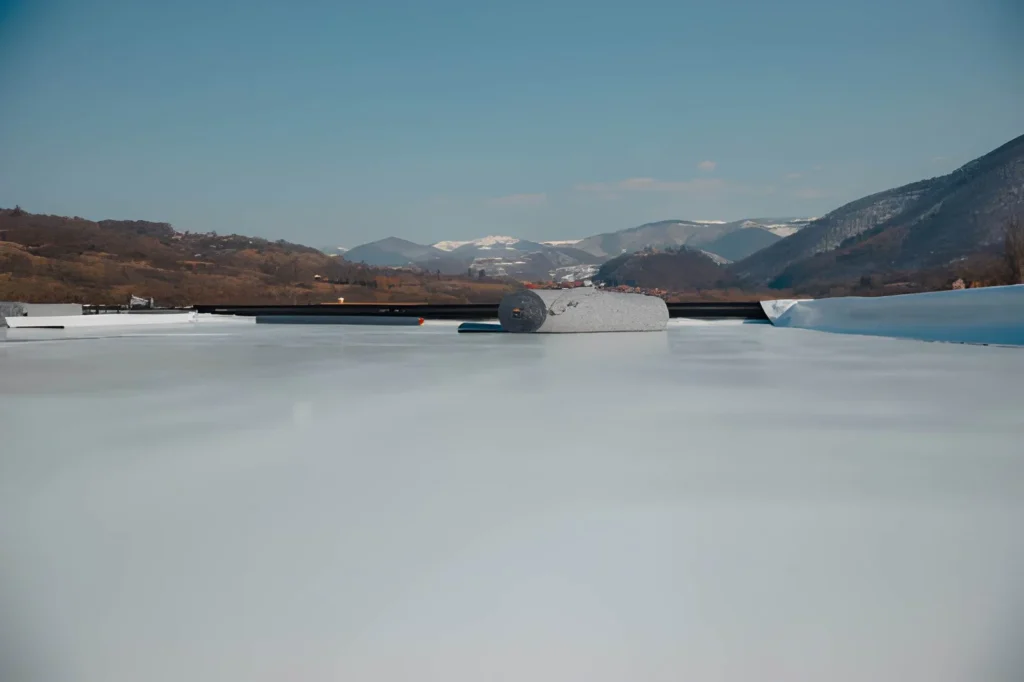
TPO fits large, uninterrupted low-slope roofs well, because its wide sheet width covers more of the field with fewer seams to weld and maintain. It’s also a common pick for roofs carrying mechanical equipment, as long as the exposure stays moderate rather than heavy grease or petroleum-based venting, which demands more from the membrane than TPO can handle.
Buildings working toward a reflective or cool-roof requirement lean on TPO’s white surface to cut rooftop heat load without adding a separate coating.
Not every roof belongs on TPO. Heavy kitchen exhaust, industrial venting or ongoing chemical exposure may make another membrane more appropriate, depending on the specific exposure.
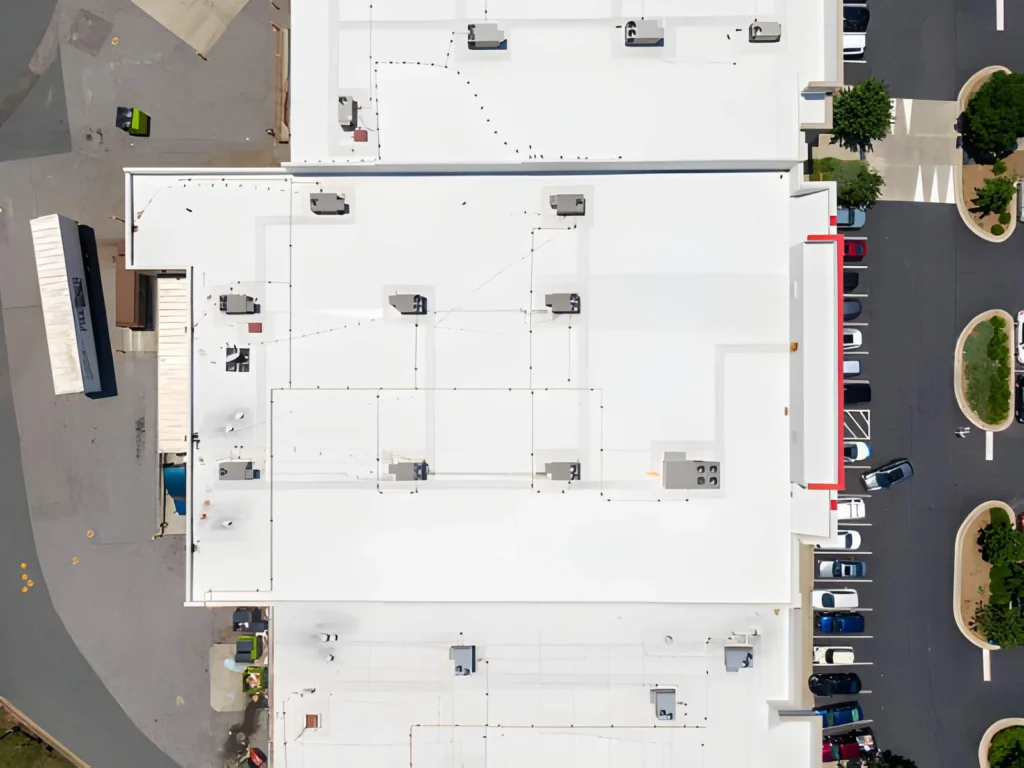
As commercial roofing contractors in NYC, we install and repair TPO roofing on properties ranging from single-tenant retail to multi-building commercial portfolios across Manhattan, the Bronx, Brooklyn, Queens, Staten Island, Westchester and Nassau.
Rooftop access can change the job as much as the membrane choice does. Moving welding equipment and rolls of material onto a rooftop above an occupied Manhattan building runs differently than a single-story property with a loading dock. A site visit accounts for these differences before we schedule a crew.
See coverage across all service areas, including commercial roofing in Brooklyn and commercial roofing in the Bronx.
In many cases, we can repair a localized TPO problem. A patch welds directly to the existing membrane, so we can often fix a section with a split seam or a damaged detail without tearing off the whole roof. Replacement becomes the better option once the membrane has aged past reliable welding or the insulation underneath has taken on water.
Detailing, drainage and traffic affect service life more than the membrane material itself. A roof holds up longer when it has properly welded seams, working drains, and foot traffic that stays on designated pads instead of the open membrane.
White is the standard color on most manufacturer lines, which is what gives TPO its reflective surface. Manufacturers also offer gray and tan sheets for buildings where a white roof isn’t the priority.
Yes. Most repair calls come from buildings where someone else installed the roof. We assess the existing membrane and seams before recommending a repair or telling you it isn’t the right fix.
Not usually. Heavy grease and petroleum exposure works against a TPO membrane over time. A different membrane, which we cover on our systems comparison page, is typically the better call for that kind of exposure.
Send us the building address and what’s going on with the roof now: a specification to price, a leak to look at, or a system due for repair. We’ll tell you straight what it needs.
Commercial roofing across Manhattan, Brooklyn, the Bronx, Queens, Staten Island, Westchester, and Nassau. MBE, DBE, and LBE certified, OSHA-compliant crews, and $2 million in general liability coverage since 2004.
Copyright © 2026 Keystone Commercial Roofing Contractors.