
Survey, system selection, tear-off, and installation on occupied buildings across NYC’s five boroughs, Westchester, and Nassau. MBE, DBE, and LBE certified, with $2 million in general liability coverage.
$2M General Liability Insurance
Common reasons to replace a commercial roof include saturated insulation across large areas, repairs that keep failing, a deteriorated deck, a system at the end of its service life, and a change in the building’s use. The right approach depends on the roof’s condition, the building’s requirements, and a site survey. Some roofs can be repaired or recovered instead.
If your roof matches one of these situations, replacement is worth a real conversation. If it matches none, a commercial roof repair may be the better fit, and a roof inspection confirms which one you need. If you’re weighing ongoing upkeep instead, see our commercial roof maintenance programs.
A full replacement follows a consistent sequence, though the specifics shift depending on the building and the system chosen.
Site logistics run alongside all seven steps on an occupied building: staging materials without ground-level yard space, coordinating access, and scheduling around a business that’s still operating underneath the work.
Permit and filing requirements depend on the scope of the work. Under NYC Department of Buildings (DOB) rules, reroofing limited to the membrane, roof covering, and insulation above the deck may not need a DOB work permit, provided the NYC Energy Conservation Code doesn’t require additional insulation. Work that includes replacing the roof deck does. Other agencies, or related work such as sidewalk protection, may require separate filings. The owner should confirm what applies with their registered design professional before work begins.
Our role is to install the specified system, assembly, and details in accordance with any approved drawings. We don’t file for permits, obtain approvals, or handle that paperwork on the owner’s behalf. That responsibility sits with the owner and their design professional.
Already working with an architect or engineer? We install in accordance with their approved drawings.
Roof replacement on a public or institutional building often runs through a competitive procurement process, and bids may include participation goals.
We hold MBE, DBE, and LBE certification. For bids with applicable participation requirements, a subcontractor’s certifications may be relevant to the prime contractor’s team and compliance planning. We can provide our documentation for review against the specific solicitation.
We work on government, healthcare, education, and private commercial buildings, and we coordinate directly with prime and general contractors who need a certified roofing subcontractor for their own bid.
Working to MBE, DBE, or LBE participation goals? Ask us for our certification details.
Keystone Commercial Roofing installs and replaces commercial roofs across Manhattan, the Bronx, Brooklyn, Queens, Staten Island, Westchester County, and Nassau County.
Installation logistics in this city go beyond the roofing work itself. Street access for material delivery, staging on a site with no ground-level yard, crane placement and street-use requirements, and scheduling around a building that stays occupied throughout the project all get planned before the first tear-off begins.
See our roof installation service in the Bronx and roof installation in Brooklyn for local detail.
Replacement is one of the services we provide as commercial roofing contractors in NYC. See all our services.
1946 Bathgate Avenue, Bronx, NY 10457. Roof installation, 2023.
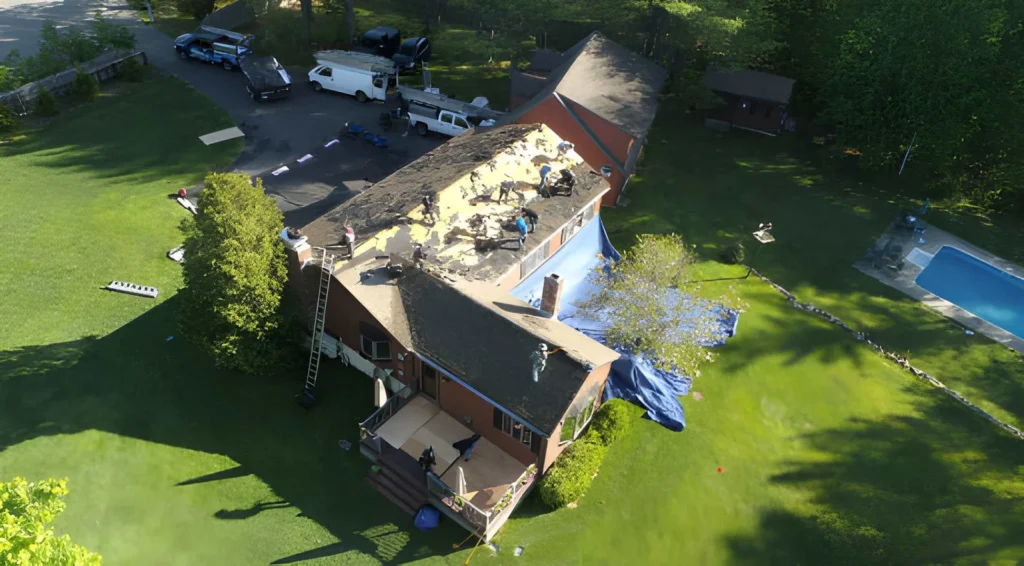
Keystone Commercial Roofing provide commercial roof maintenance across all five boroughs, Manhattan, Brooklyn, Queens, the Bronx and Staten Island, plus Westchester and Nassau Counties:
See roof maintenance in Brooklyn and roof maintenance in the Bronx for how a visit looks locally. The same standard applies whether the building is in Manhattan, Queens or Staten Island: full-roof checks, cleared drainage, and a written record after every visit.
Snow load is its own maintenance concern through a New York winter. If your roof carries drifted or ponded snow after a storm, that’s handled separately under commercial roof snow removal.
Maintenance is one part of our work as commercial roofing contractors in NYC, and all our services are listed together.
Isolated problems on an otherwise sound roof usually point toward repair. Widespread saturation, repeated failures, deck deterioration, or a system at the end of its service life usually point toward replacement. We confirm which after an actual survey, not from a description alone.
It depends on the condition found during the survey. A tear-off removes the existing roof down to the deck. A re-cover installs new roofing over an existing system and only works where the code allows it and that system is dry and sound enough to build on. Wet or deteriorated roofing, or a roof that already has two or more layers, generally rules it out.
It depends on the scope of work. The property owner, working with a registered design professional, is responsible for confirming which filings apply. We install the specified system in accordance with any approved drawings. We don’t file for permits or handle approvals on the owner’s behalf.
Yes. We plan roof access, material staging, and scheduling around the business underneath before the first tear-off begins.
The size of the roof, the system selected, whether it’s a tear-off or a re-cover, the condition of the deck and insulation, and site access. We don’t quote a number before someone has looked at the roof.
Yes, we hold MBE, DBE, and LBE certification. Whether it counts toward a participation goal depends on the agency and the solicitation, so check the bid documents and ask us for our certification documentation.
Single-ply membranes including TPO, PVC, and EPDM, along with built-up and modified bitumen systems. The right one depends on the building’s slope, use, and exposure, confirmed during the survey.
Yes, $2 million in general liability coverage, and our crews work under OSHA safety standards throughout tear-off and installation.
Send photos and the building address. We’ll look at the roof before we give you a scope or a number.
Commercial roofing across Manhattan, Brooklyn, the Bronx, Queens, Staten Island, Westchester, and Nassau. MBE, DBE, and LBE certified, OSHA-compliant crews, and $2 million in general liability coverage since 2004.
Copyright © 2026 Keystone Commercial Roofing Contractors.