
TPO, PVC and EPDM are common options for low-slope commercial roofs in New York. The right one for your building comes down to what’s on the deck now, what’s draining or venting onto the roof, and how much traffic the roof takes.
$2M general liability insurance
The core differences between the three membranes, before you get into the detail.
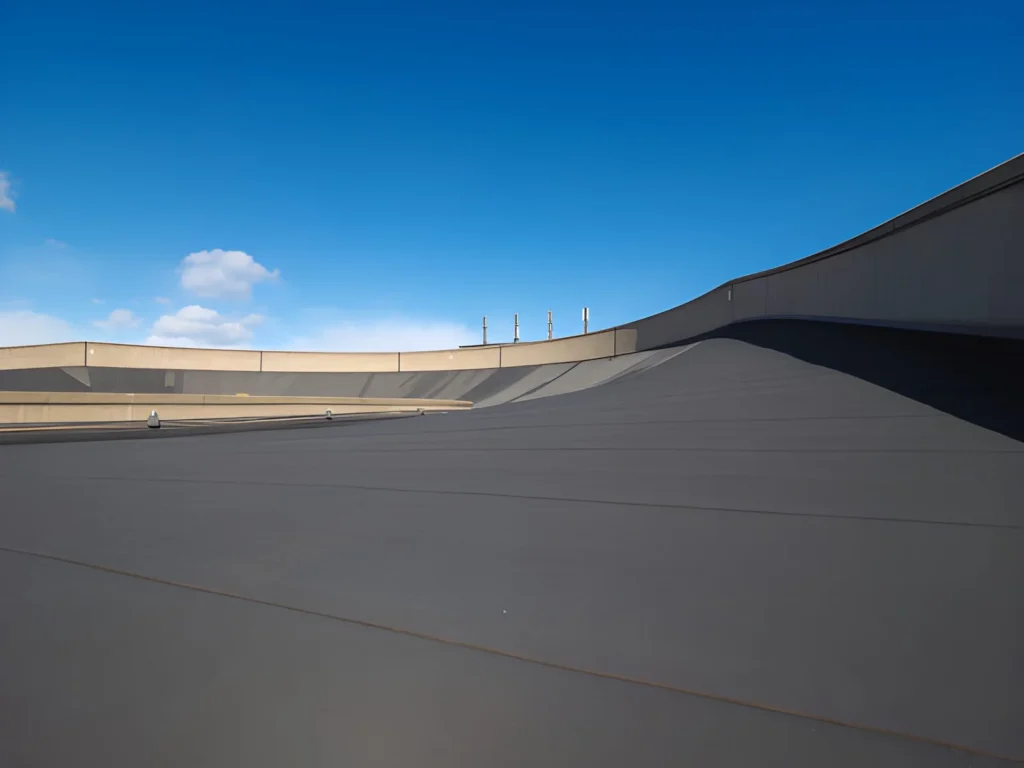
Single-ply roofing puts one continuous waterproofing sheet over the roof deck instead of building up multiple layers of asphalt and felt. That sheet is either thermoplastic or thermoset, and the distinction decides how installers seam it, repair it, and detail it at every wall, curb and pipe it meets.
Thermoplastic membranes, TPO and PVC, soften under heat during manufacturing and stay capable of softening again later. That’s what lets installers heat-weld the seams: the machine melts both sheet edges and fuses them into one continuous surface. Thermoset membranes, EPDM, cure into a fixed structure that can’t be re-melted, so installers join the seams with adhesive or seam tape instead of heat.
None of this sits directly on the deck. Insulation goes underneath the membrane, often with a cover board to protect it and give the membrane a stable surface, plus an attachment method that ties the whole assembly down. What’s already on your roof when we arrive determines how much of that assembly we reuse, and how much we replace.
Here’s how the three hold up on the details that actually change a specification, past the summary above.
| Categories | TPO | PVC | EPDM |
|---|---|---|---|
| Seam method | Heat-welded | Heat-welded | Taped or adhered |
| Standard color | White | White | Black (white available) |
| Chemical & grease resistance | Depends on formulation and exposure | Generally stronger resistance to many oils, greases and chemicals | May be unsuitable for some petroleum-based exposures |
| Typical fit | General low-slope roofs, reflectivity a priority | Kitchen venting, rooftop mechanical exposure | Standard exposure, simpler install |
Seams. TPO and PVC seams are heat-welded, fusing the sheets into one continuous membrane instead of relying on a separate bonding material. EPDM seams rely on tape or adhesive systems, so seam prep and installation quality matter more.
Attachment. Single-ply membranes can be mechanically attached, fully adhered or ballasted depending on the approved roof assembly, deck, building height and wind exposure. The specific attachment method is determined by the system specification and site conditions.
Color and reflectivity. TPO and PVC are commonly available in white, while EPDM is commonly black. Available colors vary by manufacturer and product.
Chemical, grease and exhaust exposure. PVC generally offers stronger resistance to many oils, greases and chemicals than TPO or EPDM, which is why you’ll see it on roofs that take on grease, oils or exhaust: restaurant kitchens venting through the roof, or buildings with mechanical equipment that leaks fluids. TPO suitability depends on the specific chemical or grease exposure and membrane formulation. Petroleum-based exposure can attack EPDM, which typically makes it a poor fit for roofs with heavy kitchen or industrial venting.
Foot traffic and rooftop equipment. Rooftop units, walkway pads and regular foot traffic wear down any membrane over time. TPO and PVC can be repaired using compatible membrane and heat-welding methods, while EPDM repairs use the same tape-and-adhesive method as the original seams.
Where each gets specified. TPO is a common fit for low-slope commercial roofs where chemical exposure stays moderate and a reflective, heat-welded surface is the priority. Specify PVC where grease, oils or chemical exposure would put TPO or EPDM at risk. EPDM fits roofs without that exposure, where its installation approach and long field track record fit the building.
Comparing two quotes on different systems? Send us both and we’ll tell you what’s actually different about them.
A single-ply quote isn’t priced on the membrane alone. Two buildings with the same membrane can land at very different numbers depending on what’s underneath and around it.
What’s already on the deck matters first. A roof going down over sound, dry insulation costs less to prepare than one where the deck is wet, the insulation has failed, or we need to remove old layers before anything new goes down.
Tear-off versus re-cover is the next variable. Re-covering an existing membrane skips demolition and disposal. A full tear-off adds both, and may be required when the existing assembly is too deteriorated for a re-cover or when applicable code or project requirements call for removal.
Insulation adds cost depending on the R-value your building needs and how much of the existing insulation we can salvage. Attachment method changes the balance between material and labor costs, with the actual difference depending on the roof assembly, substrate and site conditions.
Penetrations, curbs and rooftop equipment each need individual detailing. A roof with numerous or complex penetrations, curbs and rooftop units can take longer to detail correctly than a simpler roof. Access and staging eat up more of the budget here than they would somewhere with room to park a truck and swing a crane. Getting material onto a roof above an occupied building, with limited street access and no room for a crane, adds time a suburban job wouldn’t need.
Tell us the building address and what’s on the roof now, and we’ll tell you which of the three makes sense.
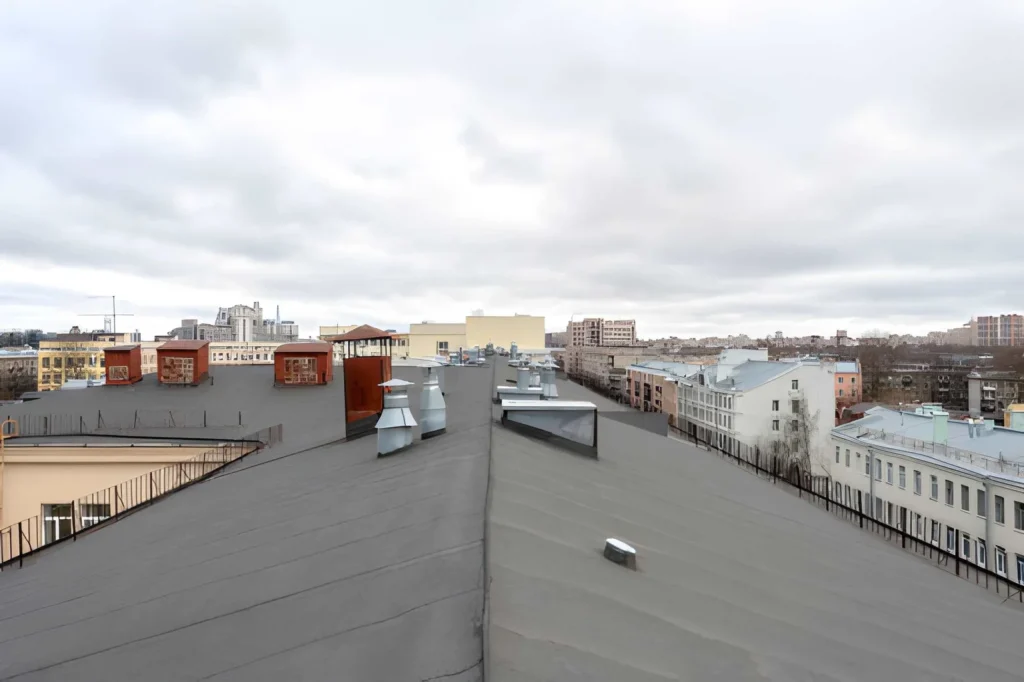
Persistent ponding can accelerate wear on a single-ply roof and may indicate a drainage problem. When water remains on a roof for days after a storm, it can increase exposure to the membrane and seams and should prompt an investigation of the drainage system.
Foot traffic outside a designated walkway wears a membrane faster than traffic that stays on protected pads: technicians reaching rooftop units, deliveries crossing to a hatch, anyone treating the roof as a walking surface instead of a waterproofing layer.
Penetrations, curbs and parapet details are common areas for leaks and require careful detailing. Poorly sealed pipe boots, curb flashings and parapet terminations can become leak points before the membrane field itself reaches the end of its service life.
Regular inspections can identify issues like loose flashing, punctures or worsening ponding before they require more extensive repairs. If any of this sounds like your roof already, that’s a job for roof inspection.
A quick pointer to which system fits your building, with a link to each one’s own page for the install details. For the full range of commercial roofing systems we install.

We install single-ply roofing across Manhattan, the Bronx, Brooklyn, Queens, Staten Island, Westchester and Nassau, on buildings ranging from single-tenant retail to multi-building commercial properties.
Access and staging change borough to borough. Rooftop access above a fully occupied Manhattan building runs differently than a single-story property with a loading dock upstate, and that’s part of what a site visit accounts for before we recommend a system.
See coverage across all service areas, including commercial roofing in Brooklyn and commercial roofing in the Bronx.
It comes down to whether the material can be re-melted. TPO and PVC can, which is what makes heat-welded seams possible. EPDM can’t. Once it cures, installers join its seams with adhesive or tape instead of heat.
Sometimes. It depends on the condition of what’s already up there, and we confirm that with a roof assessment before recommending anything.
PVC generally offers stronger resistance to many oils, greases and chemicals among these three membrane types. That’s why you’ll commonly see it specified on buildings with rooftop kitchen venting or mechanical equipment that can leak fluids onto the roof.
Yes. We regularly install single-ply roofing on occupied commercial buildings. We plan staging and access around the business running underneath, which matters even more on properties with limited street access.
Send us the building address and what’s on the roof now, and we’ll tell you straight which membrane makes sense. MBE, DBE and LBE certified, $2M general liability insurance, and commercial roofing work across New York since 2004.
Commercial roofing across Manhattan, Brooklyn, the Bronx, Queens, Staten Island, Westchester, and Nassau. MBE, DBE, and LBE certified, OSHA-compliant crews, and $2 million in general liability coverage since 2004.
Copyright © 2026 Keystone Commercial Roofing Contractors.