
Some older New York buildings have built-up roofing, modified bitumen, or a combination of both following decades of repairs and partial re-roofing. Repair often still works before replacement becomes the only option.
$2M general liability insurance
Built-up roofing and modified bitumen are both asphalt-based low-slope roofing systems, but they use different membrane constructions.
Many older buildings carry both: a modified bitumen cap sheet over an original built-up base, or a built-up roof patched with modified bitumen material over the years. That mix is why the two terms get used interchangeably by people managing these roofs.
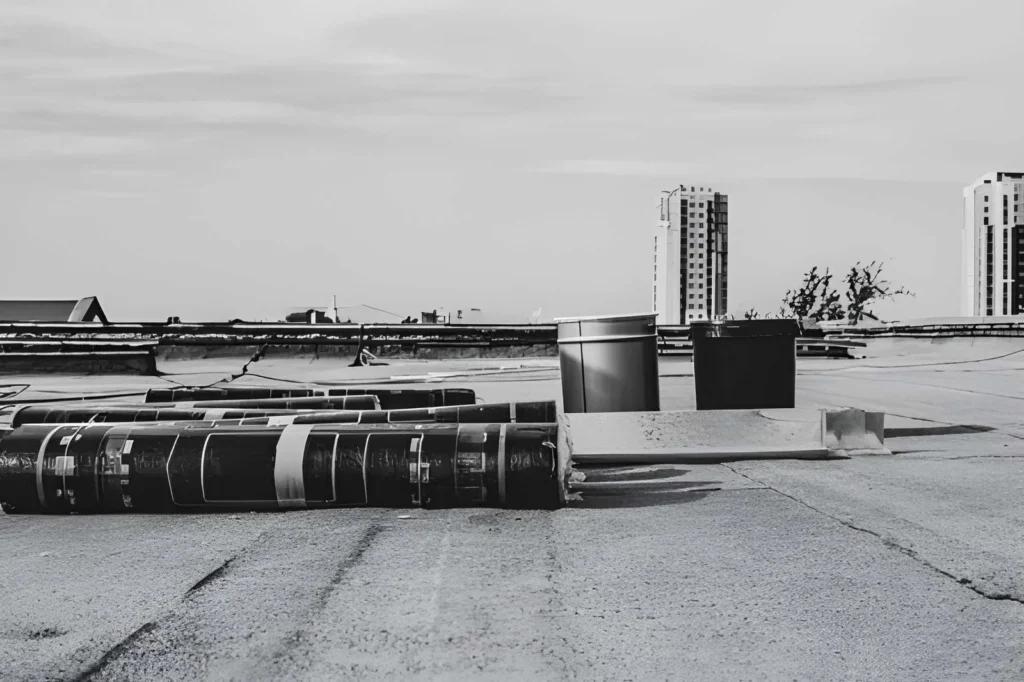
What’s under the ballast is the part nobody checks until something leaks.
A built-up roof draws its strength from how many layers it has and how well those layers bond to each other.
Gravel or a cap sheet shields those layers from UV exposure and physical wear, and it usually shows age first: thin patches, exposed felt where gravel has washed away.
Flashings, parapets, and other roof details take more movement and weather exposure than the flat field of the roof. Check them alongside the membrane itself, not as an afterthought.
Why finding the leak is the hard part: on a multi-ply roof, water can travel between layers before it shows up as a stain inside. The entry point on the roof and the damage you see indoors are often nowhere near each other.
SBS and APP are the two modifier types used in modified bitumen, and the difference changes how the roof actually performs, not just what it’s called.
Actual flexibility and weathering vary by product, so we check the manufacturer’s specification for the system in question rather than treating every SBS or APP sheet the same way.
Which method applies depends on the membrane, the roof assembly, the substrate, and the manufacturer’s instructions. Not every product works with every method.
A granulated cap sheet gives a finished modified bitumen roof its surfacing and UV protection, doing the same job gravel does on a built-up roof, just factory-applied instead of loose-laid.
Torching is a common, well-understood way to apply modified bitumen, with a long track record. It also means open flame work on a roof above an occupied building, worth raising directly rather than glossing over.
Torching shows up as the default in a lot of quotes because it’s fast and familiar. That shouldn’t make it the only option on the table. An occupied building, particularly one with sensitive tenants, active fire-safety concerns, or an insurer with specific requirements, sometimes calls for a different approach.
Cold-applied and self-adhered methods exist in the trade specifically to avoid flame.
Whether either fits your building depends on the roof itself and what you’re trying to avoid: cost, disruption, or risk. Ask us directly which of these we perform, since we’d rather give you a straight answer than a general list of what’s possible somewhere.
Raise this question before the quote arrives, not after. The answer can change both the timeline and what your building needs to arrange on its end.
Occupied building and a quote that involves torching? Ask us which flame-free options, if any, are suitable for your roof and available through our team.
Patching a multi-ply roof usually means fixing the specific failure, a blister, a split seam, a flashing detail, rather than treating the whole roof as compromised because one area is failing.
A recover may be possible when the existing roof assembly is suitable, for example, a compatible modified bitumen cap sheet installed over a built-up roof, if the existing assembly is sufficiently sound and dry and the proposed system meets applicable requirements.
The deck and the insulation decide the real answer more often than the surface does. An assessment tells you which category your roof is actually in.
Built-up and modified bitumen roofing shows up often on older industrial, warehouse, and multifamily buildings, including properties in the Bronx, where we provide inspection, repair, and replacement.
Commercial roofing in the Bronx
Working over occupied floors takes the same access, staging, and scheduling every roofing job in this city requires, with the torch question adding another layer of coordination when it applies.
We cover Manhattan, the Bronx, Brooklyn, Queens, Staten Island, Westchester County, and Nassau County.
See all roofing systems we work with, or compare TPO, PVC, and EPDM if you’re considering a single-ply alternative.
Cold-applied and self-adhered methods exist in the trade as flame-free alternatives. Ask us which specific methods we perform for your building, so you get a straight answer rather than a general list of what’s possible in the industry.
Built-up roofing is multiple layers of asphalt-saturated material assembled on site. Modified bitumen is factory-made, polymer-modified sheets installed in one or more layers. Many older buildings carry elements of both, from decades of patches and partial re-roofing.
Often, yes, once we find the actual entry point. On a multi-ply roof, water can travel between layers before it shows up as a leak inside, which is why an assessment matters more than a guess based on where the interior stain sits.
We carry $2 million in general liability insurance, and our crews follow OSHA safety guidelines. For any project involving hot work, we confirm the specific precautions and coverage details against your building before we start.
All five boroughs, plus Westchester and Nassau counties.
Call Keystone Commercial Roofing and describe your building. We’ll tell you the options honestly, not just the fastest one.
Commercial roofing across Manhattan, Brooklyn, the Bronx, Queens, Staten Island, Westchester, and Nassau. MBE, DBE, and LBE certified, OSHA-compliant crews, and $2 million in general liability coverage since 2004.
Copyright © 2026 Keystone Commercial Roofing Contractors.