
If your commercial roof is already EPDM, whether ballasted or not, Keystone Commercial Roofing assesses the existing roof and determines whether repair or replacement is appropriate.
$2M general liability insurance
EPDM is a cured synthetic rubber membrane. It cures once, during manufacturing, and keeps that chemistry for the rest of its life on the roof.
That’s the fact that shapes everything else about it. Thermoplastic membranes soften with heat and weld at the seams. EPDM doesn’t become weldable that way, its seams join with adhesive and seam tape instead, a cold process used for both the original install and every repair after it.
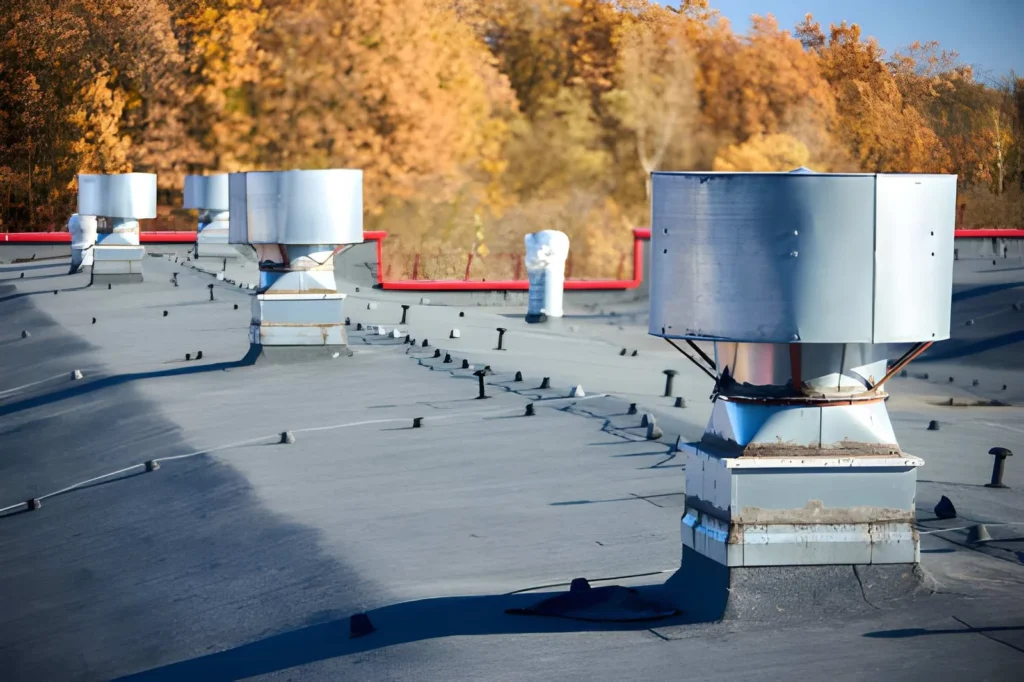
What’s under the ballast is the part nobody checks until something leaks.
EPDM seams are joined with adhesive and seam tape, not heat. That bond ages on its own timeline, different from a welded seam, and it’s worth knowing what normal wear looks like versus a seam that’s actually failing.
A visible gap or a lifted edge along the lap line, sometimes with a slight curl where the tape has let go. That’s different from a puncture or split in the field of the sheet, and the two are easy to confuse from the ground.
Most seam wear is gradual. Some isn’t, an installation defect, physical damage, or sudden deck movement can cause a seam to fail abruptly rather than age out slowly. Either way, it’s not something you diagnose from the ground.
Loose stone ballast shows up on older EPDM roofs across New York, a holdover from an era when ballasted systems were a common specification for large flat roofs.
Ballasted roof and a leak you can’t place? That’s a survey, not a guess.
EPDM goes down three ways. Which one applies depends on the deck, the building, and what the roof needs to carry.
| Method | How it holds |
|---|---|
| Fully adhered | Bonded directly to the substrate with adhesive across the full surface |
| Mechanically attached | Fastened through to the deck or insulation at intervals, then seamed |
| Ballasted | Held down by the weight of stone or pavers, no fasteners or adhesive |
Ballasted roof and a leak you can’t place? That’s a survey, not a guess.
EPDM shows up across older multifamily and industrial buildings citywide, and it’s a common membrane behind the age and building-stock profile of the Bronx specifically, older low-slope roofs on tight capital budgets, where seam condition and ballast inspection come up regularly.
Working over an occupied building means:
Where EPDM fits, and where it doesn’t: it’s usually the sensible answer on a roof that already has it, keeping the existing assembly intact through repair or a straightforward replacement. Grease or chemical exposure changes that calculation, and the right call there depends on the specific exposure, its concentration and duration, and the membrane manufacturer’s compatibility guidance, not on this membrane alone. See how the three single-ply membranes compare for that decision.
By narrowing the search first, sometimes with electronic leak detection or an infrared survey, then pulling back ballast from the likely area to confirm it. Guessing from the interior stain alone isn’t reliable, since water travels before it drips.
Often, yes. If the membrane itself is still sound, new adhesive and tape can be applied directly over a cleaned, prepared lap. Whether that holds depends on the sheet’s condition, which we check on site.
No. EPDM seams are joined with adhesive and seam tape, a cold process used for both original installation and later repairs.
Yes, $2 million in general liability coverage, and our crews follow OSHA safety practices for the access and dust control that ballast work requires.
Not for every one. It’s a strong fit for a roof that already has it. Grease or chemical exposure is a separate question that depends on the specifics of what’s landing on the roof.
We’ll tell you what we’re looking at and whether repair is still realistic.
Commercial roofing across Manhattan, Brooklyn, the Bronx, Queens, Staten Island, Westchester, and Nassau. MBE, DBE, and LBE certified, OSHA-compliant crews, and $2 million in general liability coverage since 2004.
Copyright © 2026 Keystone Commercial Roofing Contractors.